
IECC 2024 vs ASHRAE 90.1 2022
There are some significant differences between IECC 2024 and ASHRAE 90.1 2022. Those differences have significant cost implications to projects and project teams should choose carefully. Overall we recommend ASHRAE 90.1 2022 Chapter 12 Energy Cost Budget Method as it provides the most design flexibility and is generally most cost effective to comply with. Please note you should only pick one and follow for the entire project. No mix and match and no cherry picking.
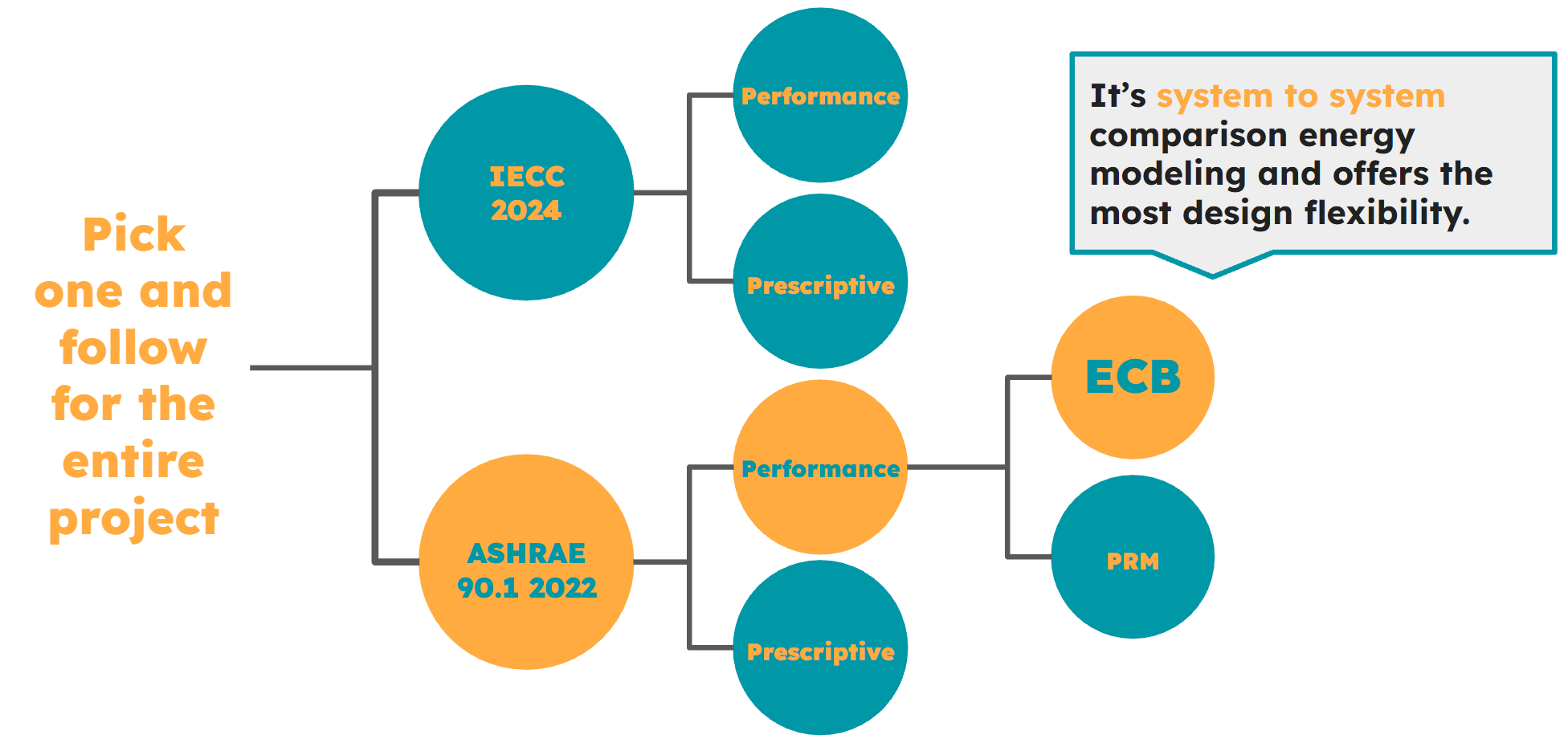
Overall Recommendation
This memo, prepared by Clearbrook Energy Solutions, outlines the primary differences between IECC 2024 and ASHRAE 90.1 2022. Our goal is to equip project teams with the necessary insights to make strategic early-stage decisions that contribute to project success.
IECC 2024
Pros
Written as a code so the language is more straightforward and easier to understand.
Most designers and AHJs are more familiar with IECC and it’s easier to find it online for free.
IECC uses Total UA for prescriptive envelope compliance, which is easier to follow.
No envelope backstop with its performance path.
Slightly less stringent and restrictive on thermal bridging requirements.
No compressed air system requirements.
Commissioning requirements are generally less restrictive.
Cons
It made considerably more items mandatory, meaning less design flexibility.
Blower door test is mandatory. Visual inspection can be used only if the project meets certain exceptions.
More stringent fenestration thermal performance requirements.
30% prescriptive window to wall ratio versus 40% in ASHRAE 90.1 2022.
Fault detection and diagnostics requirement for the entire building if it has gross conditioned floor area >100,000 sf.
Mandated door switch control.
Mandated energy recovery for applications other than non transient dwelling units.
Mandated fan power and efficiency limits.
Mandated occupied standby control.
Mandated dwelling unit electric meter.
Mandated electrical AND gas submetering when the building >=10,000 sqft.
Mandated either onsite renewable or power purchase agreement. Even if a building is exempt from onsite renewable system requirements, it still has to do power purchase agreement.
The prescriptive additional efficiency requirements are difficult to meet.
Mandated renewable and load management credits when the building >5,000 sqft.
Its performance path requires PAEC calculation, which generally requires the model to show ~25% savings. Overall it’s infeasible for most projects to comply.
ASHRAE 90.1 2022
Pros
Developed by a more technical organization and a more rigorous process.
In this code cycle, 90.1 2022 is overall less stringent and easier to comply with.
Many similar mandatory provisions in IECC 2024 are prescriptive in 90.1 2022. This means with 90.1’s performance path, design teams have much more flexibility.
Only mandates a blower door test for buildings <10,000 sqft. Larger buildings can use visual inspections.
40% prescriptive window to wall ratio, higher than 30% with IECC.
Door switch control, energy recovery, and occupied standby are prescriptive.
Fan power limit and efficiency are prescriptive.
Energy monitoring is only required when the building is >25,000 sqft while IECC is 10,000 sqft. And 90.1 2022 has no gas submetering requirements.
Onsite renewable is prescriptive at 0.5W/SF based on the total of the largest three conditioned floor area. It can be traded off with the performance paths.
The prescriptive additional efficiency requirements are easier to meet than IECC 2024.
Its energy cost budget method is much easier to meet as most projects only need to show 5% better rather than ~25% better in IECC.
Its commissioning process is well defined in its Appendix H.
Cons
It’s 468 pages long. It’s a very technical document to follow and understand. Its language is also more descriptive and confusing. It’s also less accessible. ASHRAE offers a read only version but the website is not easy to navigate.
Most designers and AHJs are not familiar with ASHRAE 90.1. Project teams often need to explain why it’s allowed as the alternative.
It has a lot of equations that require two steps or even more calculations.
Its thermal bridging requirements are more broad which also covers roof edges, and any other point and linear thermal bridging.
It has an envelope backstop for its two performance paths.
Its Performance Rating Method is generally infeasible to comply with as it uses the stable baseline methodology.
It’s less defined when the scope is an existing building. IECC in some scenarios can be more straightforward.